Vanessa’s Story
The doctor would like to speak with you", the nurse said.
I had just woken up from anaesthesia after a colonoscopy, but even in my foggy state I knew this was a bad sign.
Sure enough, the news was soon delivered. We found a tumour, and it is cancer. I stopped listening after "cancer", and was only able to piece the rest of the conversation back together later with the help of my husband, who thankfully was in the room with me.
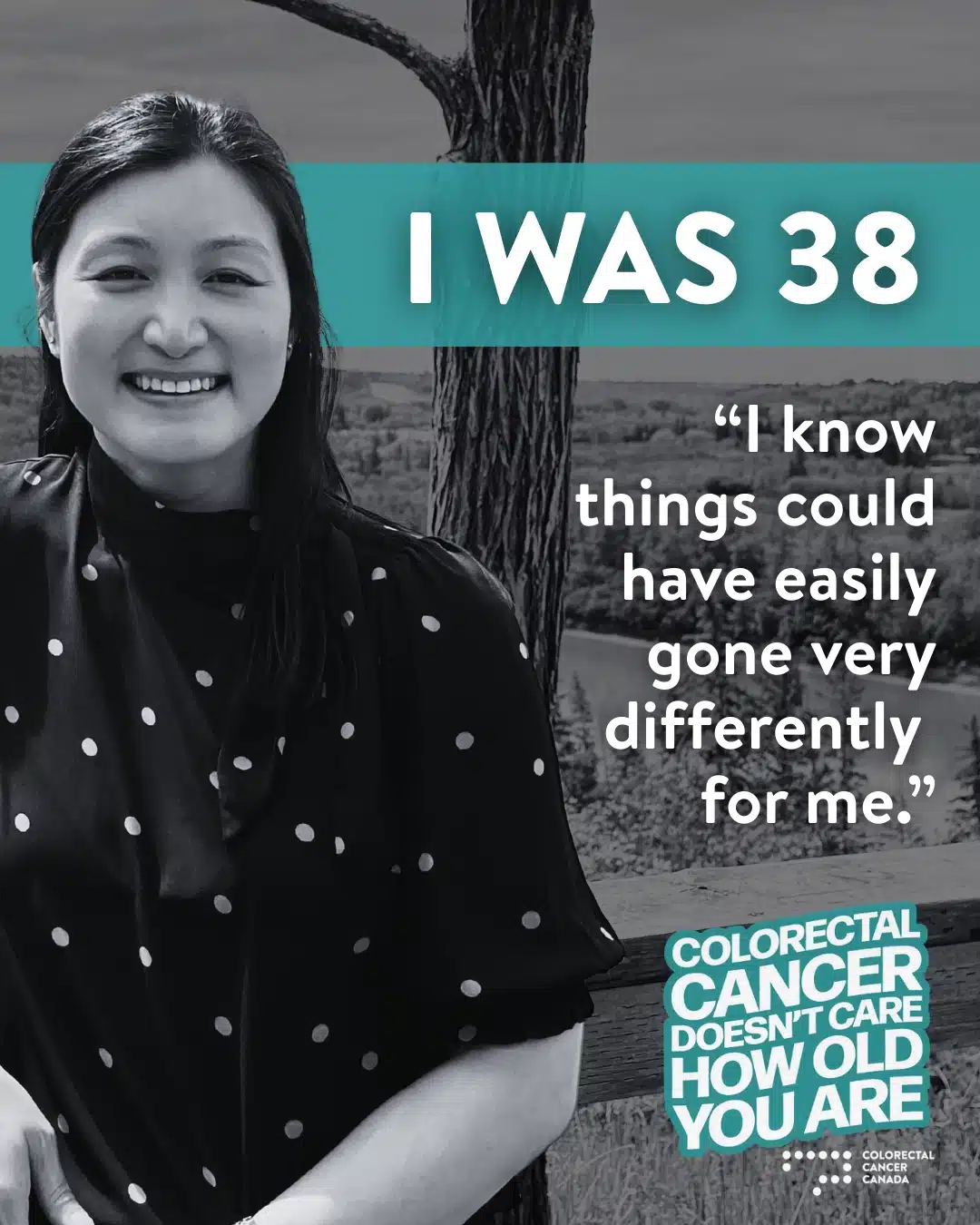
The funny thing is that cancer is an old friend of mine. I did my PhD in breast cancer research. There was a time when all I did was read about cancer, talk about cancer, and run experiments to better understand cancer. But it turns out that the exposure therapy doesn't make it any easier to cope with joining the 1 in 19 Canadian women who develops colorectal cancer in her lifetime. Especially at 38 years old.
A few weeks earlier, I had been on a work trip. One afternoon after a busy day of meetings, I went to the bathroom and had the bloodiest bowel movement of my life. I called my friend who I had planned to have dinner with that night and asked her to take me to the ER instead.
The doctors checked me over and recommended that I seek a colonoscopy once I returned home. If I'm being honest, I very nearly didn't schedule the colonoscopy. The bleeding had stopped after a day. I reassured myself that the episode could have been caused by any number of things. It could have been a hemorrhoid. It was probably a hemorrhoid.
But a week after I got home, there was blood again. Not as much as the first time, but enough that I took the hint.
Today, I'm almost three months post a surgery to remove the tumour along with 13 cm of colon. The cancer was stage 1 and the prognosis is very good with surgery alone. I feel unbelievably fortunate that we found the cancer early, that the workup uncovered other medical issues for which I was completely asymptomatic, that I live in a place where I could receive excellent care, and that I have loving family and friends who absorbed my anxieties and tears with patience and grace.
I know things could have easily gone very differently for me. If not for my unusually early symptom, the cancer would have been far more advanced by the time we found it. Screening only starts at age 50 for average risk individuals in Canada, but colorectal cancer rates in young people have been rising for several decades. Screening practices in this country need to be updated to meet this reality. I can't help but think about how many of my peers may not benefit from early detection as I have.
I got very lucky. I plan to do what I can to pay it back, including by being the weird, intrusive friend who asks about your bowel movements and is pushy about colonoscopies.